Reflections on wholeness, self-energy, IFS and the living field
Hello friend,
I'm writing this on my return from co-facilitating the first IFS in the Living Field immersive workshop with Natural Academy. And it's reminded me, again, of something I've always known. Wholeness is never about being fixed, complete, done.
On this three-day immersion, we met the land. Sat with it, walked it, let it get under our nails, our skin, and into our conversations, until place and each other and ourselves stopped being three separate things to arrive at and started being one thing we were already inside of, one ecosystem. I'm landing back now, energised, thoughtful, and profoundly grateful for the wonderful, creative, alchemical thing we created together. It's re-energised my thinking around IFS, self-energy and wholeness.
One of the most profound moments of the whole immersion didn't actually happen during it, but it did make it all make sense to me in a new, more certain way. It happened on the first evening, on an ordinary walk, mulling over the day. I went past a copse where a dog walker was chatting with a woman. She had two big bags with her, one full of plastic tubs, one of water bottles. She was asking the dog walker if she had any spare pots at home.
I slowed down enough to catch what was going on. She was putting water out for wildlife and coming back most evenings to refill the tubs. She was saying something about the birds, how it looked and felt to her to see them panting in the heat. That was it. That was the whole moment. And it took my breath away. Tears, on an ordinary Tuesday evening, over two strangers and some plastic tubs of water for wildlife.
And why? Because it was the real-world proof I needed. We are deeply connected, and we know this; we are a part of this web of life, and we do care. The trance of separation keeps us forgetting it, keeps telling us we're one thing over here and the birds are another thing over there, and the heatwave is happening to them, not to all of us together. But deep down, we remember, we do care for our fellow beings, and we need each other. There it was, unasked for, uninstructed, on a footpath near a copse, nothing to do with any workshop at all. Just what we do, underneath the forgetting, we cannot be OK when the world around us is suffering.
That ordinary moment stayed with me through the rest of the three days, because it's the same thing I'm always chasing in my work. What does self-energy actually feel like for someone, and how much of it depends on what's around them, not just what's inside them? Often in my work, I'm supporting people to discover what self-energy is like for them. Because it varies. Culturally, situationally, neurologically. Access to it varies too. So when we look inside ourselves, and into the nature that we also are, there is this energy, in and between all beings. And it's reflected in the beauty, yes. But also in the reality of wholeness in the natural world. Life and death. Ferocity. Kindness. Reciprocity. Interconnectedness.
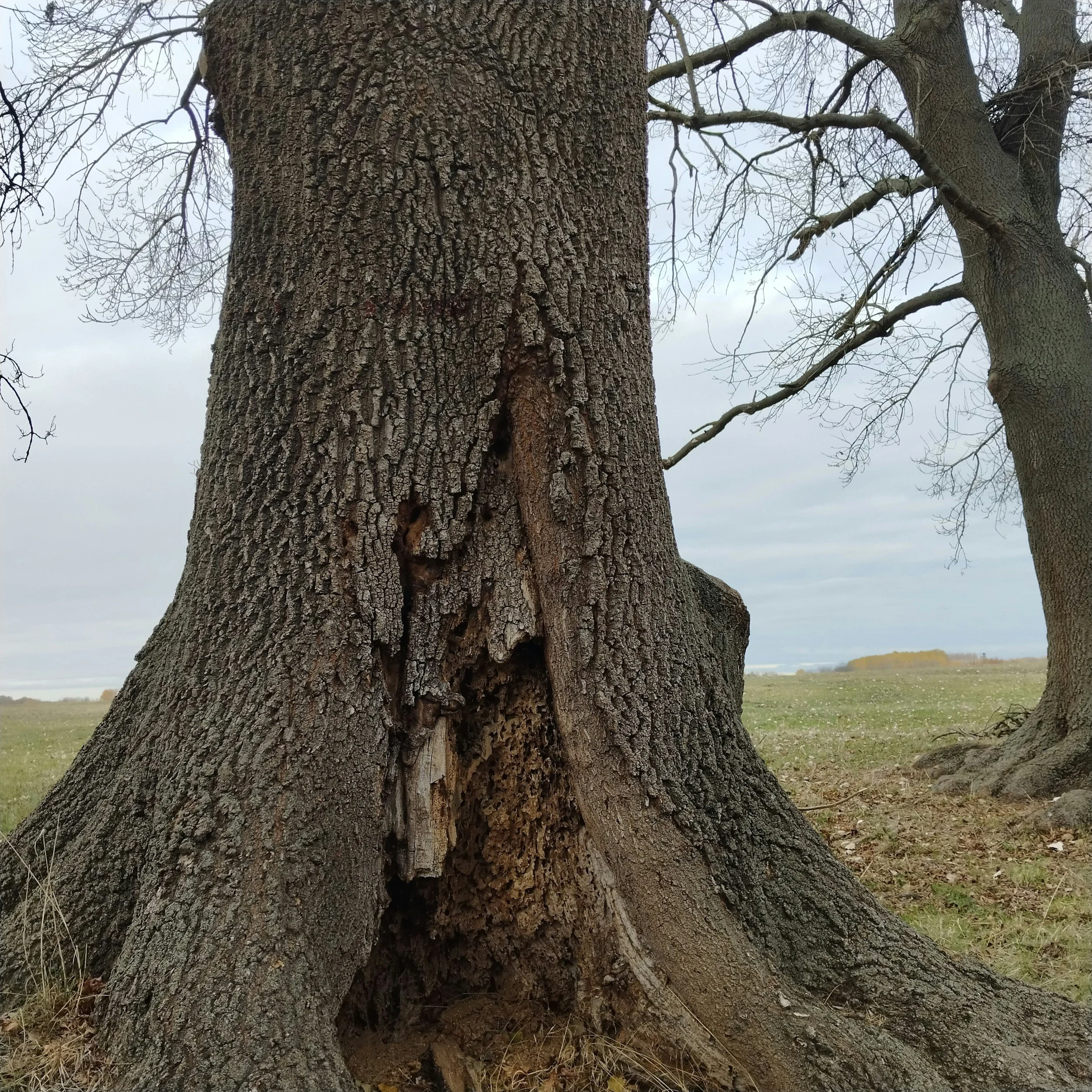
The word wholeness tends to conjure up a finished, static state. Calm. Resolved. All the broken bits smoothed over or sent away somewhere we don't have to look at them. Singular. One whole, one complete human, project, item. But that's not what wholeness looks like anywhere in nature. The oak is no less mighty for the branches lost to storms and wind. The river is no less whole for its winding path around rocks and through floodplains. Nothing is ever really finished. It keeps circulating, the breaks and ruptures included, grown around, cycled back into the web of life. That's what I mean about the oak. It doesn't hold itself apart from the break to stay whole.
A dictionary definition I look up as I write this has wholeness as "the quality of being or feeling complete and not divided or damaged." So is it a limitation of language, our imagination, or our conditioning that the word itself conjures this? One whole thing. And a human quest for wholeness gets tangled up with a quest for perfection, for being a complete person. This is what much of the wellness industry thrives on: buy this book, do this course, take this supplement, and you will be optimised. But what is a complete person? Does anyone ever really get through this life undamaged?
Look at wholeness in nature, in ecosystems, and it's obvious straight away that no one thing is whole by itself. The wholeness is the web. The wholeness is the system. A tree isn't a tree without the mycelial network connecting it to its neighbours in the forest. Any air-breathing creature is innately connected to the trees and plants that produced the oxygen it's breathing in the first place. And we breathe out carbon dioxide, and that feeds the trees back. There is no one wholeness sitting there on its own. Wholeness is a system. Wholeness is an ecosystem, a complete ecosystem.
So what happens when we move away from wholeness as perfection, wholeness as completion, and look at self-energy through this lens instead? Or healing, more widely? What if it's not about aiming for a complete, perfect, undamaged human, but something deeply, perfectly imperfect? Interconnected with so much more than just oneself. If we're aiming for healing and wholeness as human beings, what are we actually aiming for?
That question is the one underneath everything else here. IFS gave the therapy world parts. But the other huge shift was this: the idea that we all have access to self-energy, and so we can all heal. That's already a radical claim. But add this understanding of wholeness in, and it goes further. If self-energy isn't something one person holds alone, but something that arises in a system, then access to it isn't only a fact about the individual; it's a fact about the field they're in. It can be borrowed, amplified, activated by what's around you. Other people. Land. A particular tree. Ancestors.
Which means healing was never purely something you achieve on your own in the first place, and healing alone isn't wrong or wasted, just partial by design. It's something a system does together, the way a forest holds a tree upright as much as the tree's own roots do. The fuller picture needs the web, not only the node.
And it changes how I see what I'm doing as a therapist. If someone's defences come down because the whole system around them is relaxed, rather than because they personally negotiated something into stepping back, then my own regulation is part of the mechanism, not just supportive scaffolding around the real work. The room is part of it. The land is part of it. I'm not just holding space for someone to reach their own self-energy. I'm helping build the wider conditions that make reaching it possible at all.
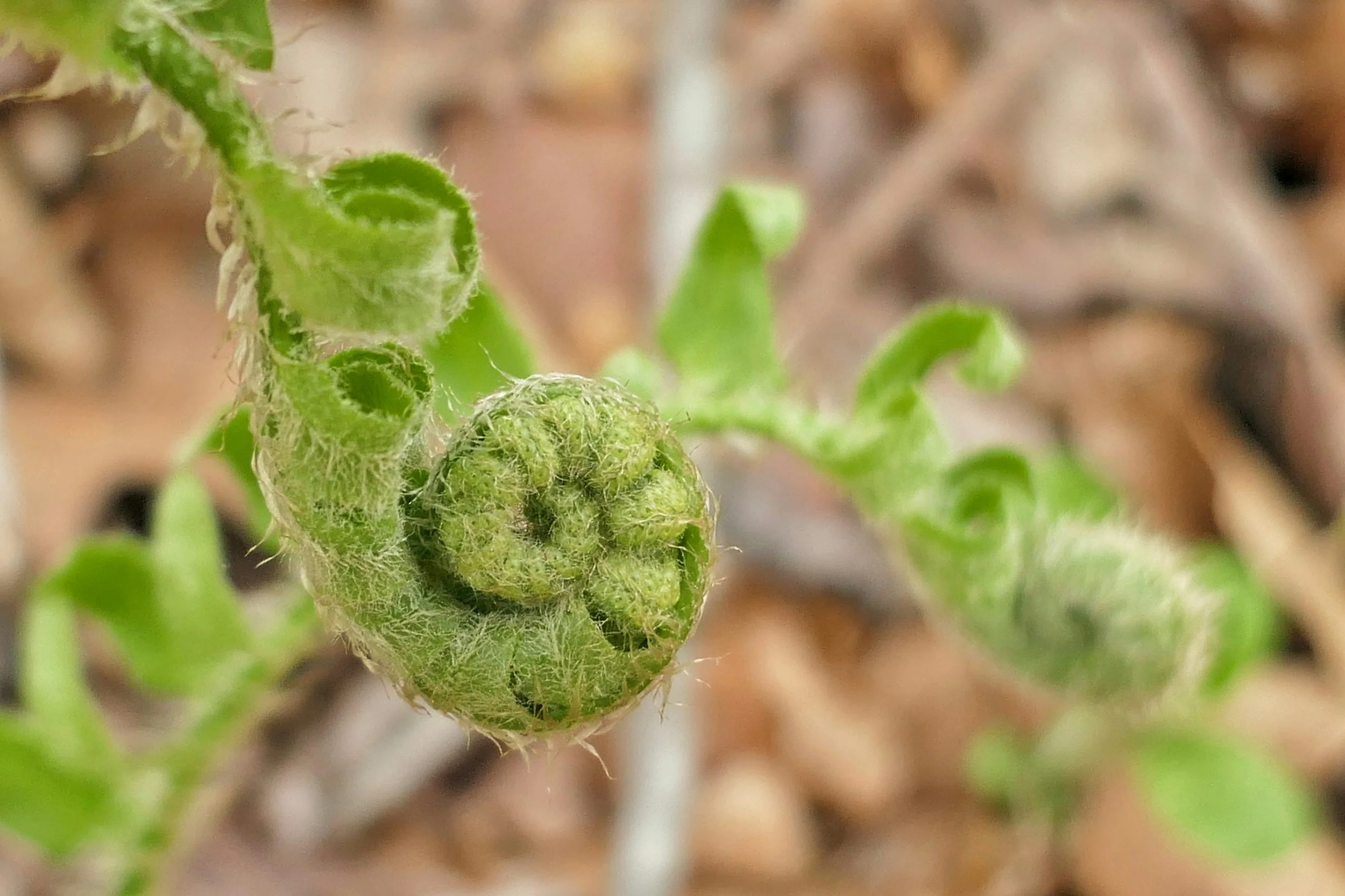
It fits the cyclical thing too, the going round and round. If self-energy were something you earned once and kept, healing would be linear. Get it, keep it, done. But if it's ecosystemic, it makes sense that it moves. Recedes. Returns. Needs re-tending, the same as any living system does. The paradigm shift was never that everyone can heal. It's that healing was never a solo act to begin with.
The goal of IFS can be misunderstood as a process of only going to exiles and ridding ourselves of burdens. Letting them go away. But where do they go? Nothing in a woodland actually leaves. And it never stops moving. Deadwood becomes habitat, then soil that feeds roots. The tree doesn't heal by getting rid of the broken branch. It heals by growing new tissue around the break and letting the dead wood keep doing its work. Hosting fungi. Insects. Birds.
This makes me think about my own healing journey, which is, in fact, deeply cyclical. It's not that an exile gets unburdened, or a healing happens in a therapy room somewhere, and then I never feel that wound again. I feel those things again. I meet them again. We go round and round and round in life, but it's different every time, because I am different every time. It's not that the wound isn't there. Like a tree, it's not that I haven't had the lightning strike. It's how I go on being. How I persist and grow rather than stopping and giving up.
I think a lot of the stuckness we experience as humans is because our protectors are holding on so tightly, with their "Never Again!", that they can't allow anything to happen. So we work with them to understand their fears and validate their intentions; growth only comes through unstuckness. But it's not growth in spite of our wounds, or away from them. It's with them, and through them.
In IFS, we talk about self-energy connections on a horizontal and a vertical plane. Horizontal being connection with the other, the therapist, the other human. Vertical being connection with ourselves. But maybe what we're looking at here needs a much wider bandwidth than that, something closer to mycelial, self-energy not sitting inside one node but moving through a network.
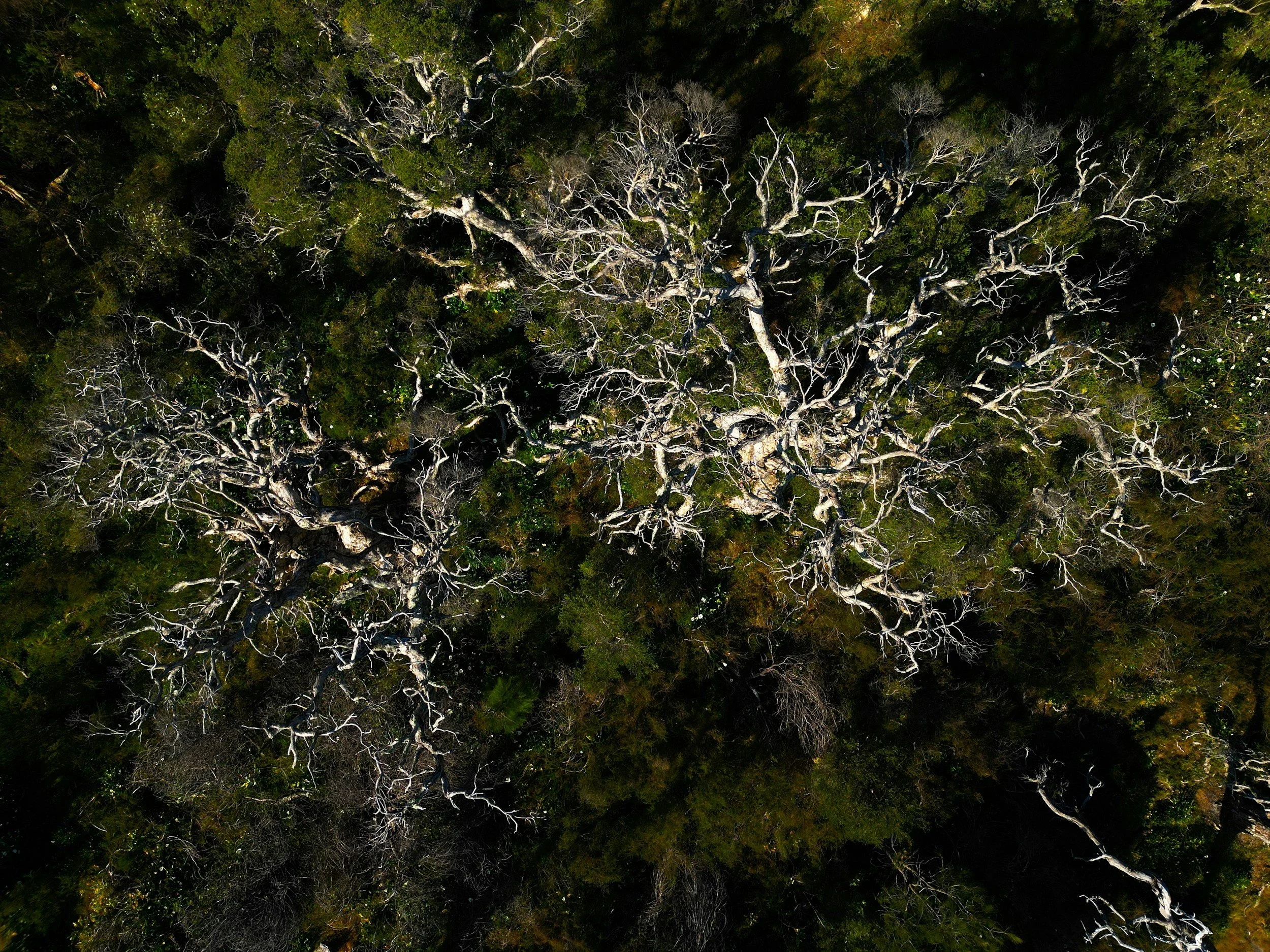
So wouldn't a self-led system look more like the oak or the river than some ascendant, perfect, singular person? Not a state you arrive at once the burdens are cleared. An ongoing capacity to stay in exchange. With your own parts. With others. With what's composting and what's growing. What if our wounds, our shadow, our burdens, can all be composted, alchemised, and transmuted through connection and witnessing from self-energy?
That wasn't just a nice idea to sit with, though. It was being asked of us directly. It isn't possible to do this kind of reconnection work with the natural world without facing into the harder feelings too. Grief for what's being lost. Rage at how carelessly this happens. Fear of what's coming. And underneath all of it, the brutality of how disconnected we've let ourselves become, loneliness that doesn't go away just because you're the one holding space for other people's pain, an aching to belong that most of us carry around unnamed most of the time.
What I noticed, watching this happen over three days, was that the material came up because the container was safe. And the container was safe because there was strong human holding, yes, but something more than human holding, too. I watched people's nervous systems open, and in practice, it wasn't that anyone was having to ask their protectors to stand down. The protectors were relaxed because the whole system was relaxed, because of the land itself doing some of the holding, a particular tree, a particular stretch of ground. This isn't bypassing. It's not about getting past defences or working around them. The defences were down because they didn't need to be up.
That's what a self-led system modelled on the oak gives you. Not the absence of the ache. Room for it. Room for it to keep circulating rather than being something you're meant to get rid of.
So maybe this is the invitation. Not to arrive somewhere finished. Not to get yourself fixed, or complete, or done, and then stay that way. But to notice what you're already part of. Your own healing was never just yours to do alone, whatever the room you did it in told you. It moves through you the way it moves through soil and roots and rivers, through the people who held you and the ground that held them. That doesn't make the ache less real. It makes it less lonely.
I think of that woman with her bags of pots and bottles, going back most evenings whether anyone saw her or not. Nobody taught her that. Wholeness was never going to be the neat thing. It was always going to be the oak, giving anyway, the lightning strike and the new growth both true at the same time, the wound still there and the healing still real, going round and round and different every time because of the work done in between. The large and the tiny, both landed in the same body, on the same land, over the same three days. And in you too, wherever you're reading this from.