IFS and Ecotherapy, where do they meet?
This is about where Internal Family Systems and ecotherapy meet, or maybe where they’ve always met and we just haven’t been naming it. I’ve been thinking about how nature is already present in IFS, and what changes when we take that seriously, not as metaphor, but as part of the field. I hope this lands somewhere thoughtful for you.
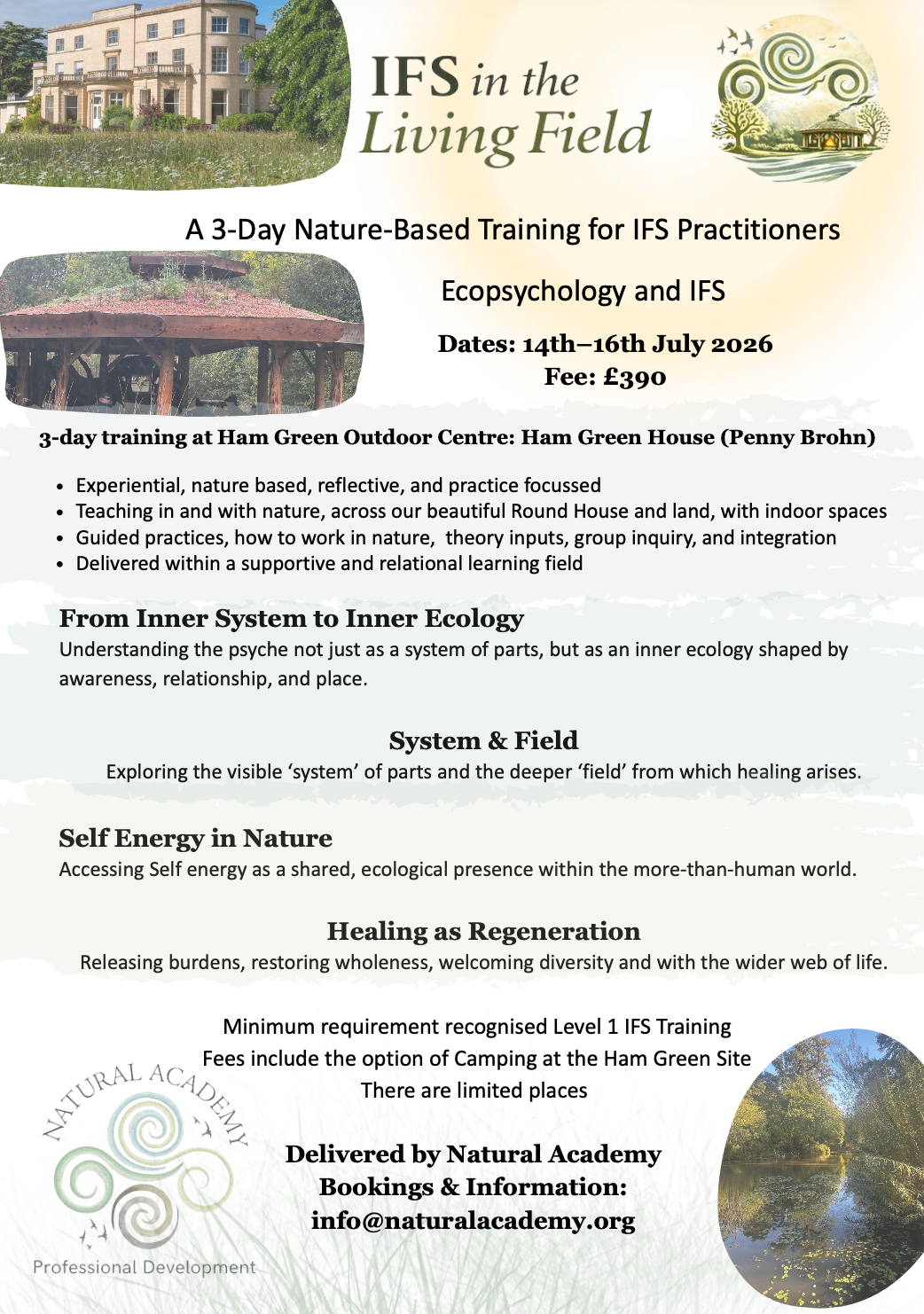
If you want to explore more, this summer I’m taking this into a three-day training on IFS in the living field with Michéal Connors, director of Natural Academy. Details at the end.
I’ve been a student of IFS (internal family systems) for the past 5 or 6 years. In that time I’ve studied the levels, gained certification and recognition as an Approved Clinical consultant. I love IFS, no therapy model has ever spoken to me so clearly and given me such an effective framework for working with my clients, and myself.
I love IFS, I love the work, the community, and the change it offers people. I love how non-pathologising, respectful, and consent-based it can be. As a student of ecopsychology and ecotherapy, too, I’ve been in a process over the past 18 months of wondering where these two meet.
Something that I have been aware of is that IFS already includes nature, the more-than-human, quite explicitly, but we don’t always think about it like that. And I don’t mean in a vague “everything is connected” way, I mean very specifically in how the model actually works, in practice.
When we work with safe place imagery with clients, they almost always go somewhere in nature, somewhere outdoors, a field, a forest, a cabin in the woods, a beach. Somewhere alive. Often with quite specific weather, a calm day with a warm breeze, or it’s raining but they’re inside by the log fire.
And then with unburdenings, we’re literally inviting parts to give things to the elements. Fire, water, air, earth. That’s in the model. No one really questions it. And time and again, the parts know exactly how they want to do this, letting some burdens burn in fire, allowing some to disintegrate on the breeze, and others to flow away in water or be buried in the earth. So something in people already knows to go there. But we still talk about IFS as if it’s happening inside a person, one system, or between two people in a room, two discrete systems.
The legacy of rationalism and splitting…
I think what I’m bumping up against is this: Even though IFS is very different to a lot of other therapy models, it’s still coming out of Western psychology, Western medicine, Western minds.

And Western psychology doesn’t come out of nowhere. It comes out of a particular way of seeing the world that took hold in Europe, and was spread out through colonisation, a few hundred years ago. The bit people often point to is the Cartesian split. Mind and body separated. Humans separated from nature. Rationalism and thinking elevated above everything else.
“I think, therefore I am” had very real consequences for nature, for non-white bodies, for women, all of whom were ‘less than’ rational male minds. If humans are defined by rational thought, then anything seen as less rational becomes lesser. And if nature is not alive, not relational, not something we are part of, then it becomes a resource.
Something to use.
Something to extract from.
At the same time, life starts being understood in mechanical terms. Bodies as machines. The world as something that can be broken down, studied, and controlled. That way of thinking gave us huge advances in science and medicine. But it also made it much easier to justify domination.
Of land.
Of other species.
Of other genders.
Of other humans.
This is where it connects to colonialism, eugenics, white supremacy, patriarchy, and religions that see man (and I do mean man) as superior to all other life. Not as simple cause and effect, but as part of the logic that allowed those systems to exist and sustain themselves. If some people are seen as more rational, more “fully human”, and some less rational, less human, less moral, then hierarchy makes sense inside that worldview and justifies it’s atrocities.
If land is seen as inert, then taking it isn’t a violation, it’s progress.
And then layer onto that a few hundred years of agricultural science, industrialisation, and capitalism.
Land reorganised for yield.
Waters redirected, contained, polluted.
Whole ecosystems fragmented or erased.
Not everywhere, not completely, but enough that we’re now living with the consequences.
From disconnection to reconnection
We’re in a time of ecological crisis. That’s not dramatic language anymore, it’s just reality. And I think it’s understandable that a lot of people turn away from that. I did. For a couple of decades, I really couldn’t engage. It was too much to go from “save the whales” as a kid to the reality, as an adult, of how little was actually being saved, and how much was still being lost.
It felt overwhelming. Pointless, even.
So I just didn’t look.
I don’t think that’s unusual. I think a lot of people, including therapists, have parts that manage ecological distress by disconnecting from it. Which makes sense. It’s a lot to hold. And at the same time, there’s also a lot happening that doesn’t get as much attention.
People are working to restore and return land.
Protect waterways.
Rewild ecosystems.
Rebuild relationships with place.
Not in some idealised way, but in very real, grounded, often difficult ways.
For me, returning to the land, both personally and in my work, feels like a form of activism. Not activism in the loudest or most visible sense, but in the sense of relationship.
Paying attention again.
Allowing connection again.
Letting that shape how I live and how I practise.
Something else that’s been influencing how I’m thinking about this is that I’ve been studying shamanic practices recently. And what’s striking there is that in animist cultures, there wasn’t this split in the first place.
Humans weren’t separate from nature. There wasn’t even a word for “nature” as something distinct, because it wasn’t needed. The land, the plants, the animals, the elements, they were all part of the same relational field. Not symbolically. Literally. And I’m not saying we can or should just adopt those ways of being wholesale. There are real issues around appropriation and context.
But I do think it shows us something. That the way we currently see the world isn’t the only way humans have ever seen it. It’s one way. A relatively recent one.
So maybe part of what’s happening now isn’t about learning something new. It’s about remembering something we’ve lost the language for. Or maybe lost the permission for.
And this is where IFS becomes interesting again. Because IFS already asks us to relate internally in a very different way. To see parts as having their own perspectives, their own roles, their own forms of intelligence. It moves us away from a purely rational, top-down understanding to one of interconnection, an inner ecology, connected by self-energy, but not controlled by it.
So if we can do that internally, it’s not that big a leap to begin to look outward in a similar way. To relate to the more-than-human world as something we are in relationship with, not something we are separate from.
I’ve been noticing in my own work that when nature is brought into the foreground, something shifts.
And I don’t think it’s just because it’s “relaxing”.
It’s more like the frame changes.
Parts are still there, but they’re not the only thing.
There’s more space.
More context.
More relationship.
And again, not in a bypassing way. If anything, sometimes things feel more real, not less. But less contained. Less stuck.
And then there’s the practical question.
What does this look like if you’re not working outdoors?
Because most people aren’t. And I don’t think this depends on being in a forest. I think it depends on attention. On whether we include the living world in how we orient.
A window.
The weather.
Light.
A remembered place.
The body’s response to all of that.
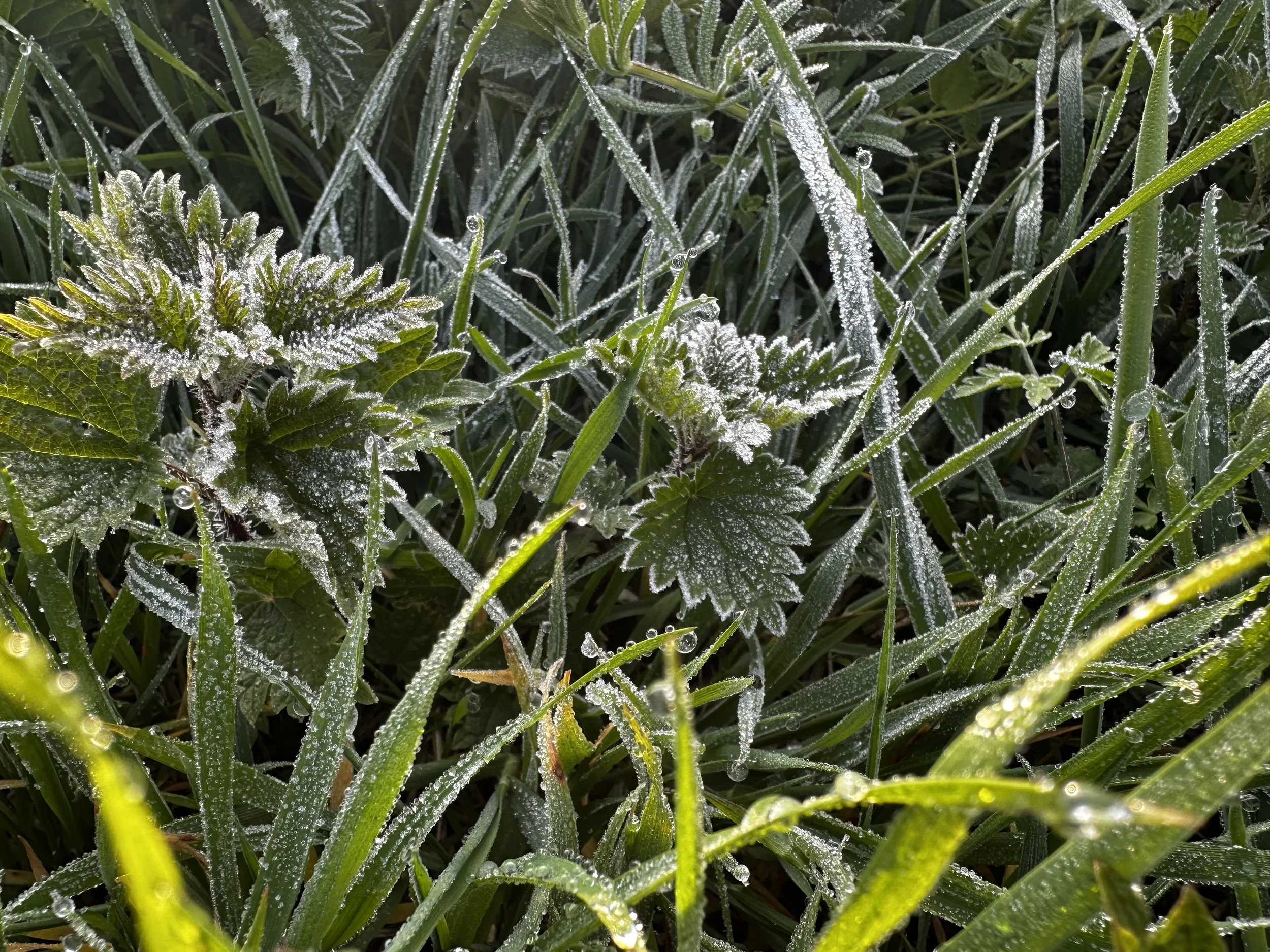
And maybe also very simple, tangible things.
Nothing complicated.
Sitting in the same place regularly and just noticing what’s there. (a “sit spot”, if you want a name for it)
Learning the names of the plants around you, even just one or two, using an app or a book
Drawing them, badly or well, just to actually look
Finding out what’s happening locally in terms of conservation or restoration
Drinking your tea outside instead of inside
Walking without headphones and noticing what’s already there
None of that is revolutionary. But it does something. It shifts relationship. It doesn’t have to be dramatic to be meaningful.
In conclusion…
I think what I’m landing on, if I’m landing anywhere, is that IFS and ecotherapy don’t need to be forced together.
They’re already touching.
And maybe part of the work now is to take that seriously.
Not just as metaphor.
But as relationship.
This still feels unfinished, but maybe that’s the point. We’re in the middle of something. Ecologically, culturally, therapeutically. It does feel like a kind of tipping point. Not in a neat, optimistic way, but in a real one. Things are changing, whether we’re ready or not.
And I think the question underneath all of this might be something like: What does it mean to practise therapy as if we are part of the living world?
Taking this deeper…
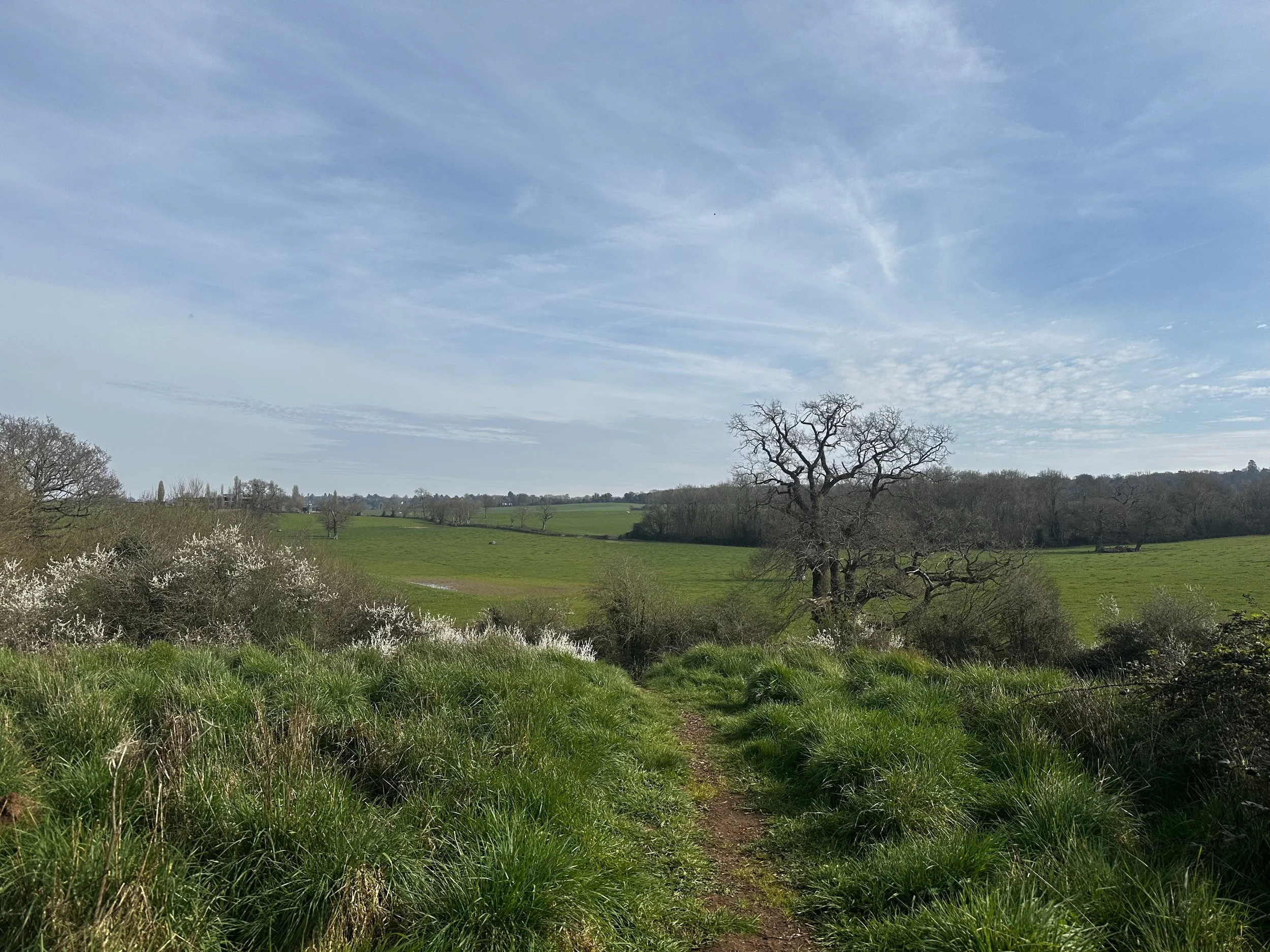
This summer, I’m taking this into something more practical. I’m running a three-day training on IFS in the living field with Michéal Connors through Natural Academy. It’s for IFS practitioners and therapists who are curious about what happens when we stop treating nature as outside the work and start including it as part of the field. We’ll be working experientially, in and with the land at Ham Green, exploring parts, place, and what shifts when the more-than-human is part of the process.
It’s not about becoming an ecotherapist in three days, it’s about actually experiencing this and finding your own way into it. You don’t need any outdoor experience to come and take part, just an open heart and some curiosity. It’s running 14th to 16th July 2026, with camping available on site. A few places are remaining, and you can get more information or book via info@naturalacademy.org.